
Every e-commerce store wants to increase its Average Order Value (AOV), but simply showing a grid of random, "related" products is a relic of outdated, static merchandising. Modern shoppers expect a smarter, more personalized experience. To effectively boost revenue, you need to move beyond basic suggestions and implement a sophisticated product recommendation strategy.
This article is a strategic guide to the advanced recommendation models that are proven to drive sales. We will explore sophisticated types like "Frequently Bought Together," personalized behavioral suggestions, and rule-based up-selling and cross-selling that do more than just show products—they enhance the entire customer journey. By emphasizing how AI-powered recommendation systems improve product discovery and customer loyalty, this guide will provide actionable insights for your store.
What are product recommendations?
Product recommendations are personalized item suggestions shown to customers as they shop on an e-commerce platform. Unlike static content or manual merchandising, where every user sees the same generic grid of products, these suggestions are a dynamic part of a broader personalization strategy. They are generated by algorithms that analyze a rich stream of data, such as a user's browsing history, past purchases, and product attributes. The core purpose of these personalized recommendations is to enhance the shopping experience by improving product discovery—guiding customers to relevant items they might not have found through generic browsing. This leads to an increase in customer engagement, improved loyalty, and ultimately, a boost in sales. Right now, 71% of e-commerce sites offer product recommendations.
How do recommendation systems work?
Recommendation systems, often called recommendation engines, are the underlying technologies that analyze vast amounts of customer data to generate personalized product suggestions. They function by collecting a wide array of data points, such as page views, past purchase history, and even product ratings. This collected data is then fed into sophisticated algorithms.
Powered by machine learning and AI, these systems analyze the data to identify patterns and predict a customer's interests. The ultimate goal is to dynamically tailor recommendations to each individual, moving far beyond the limitations of static, one-size-fits-all merchandising. This personalized approach enhances engagement and is a core component of a modern strategy for driving conversions.
The algorithmic foundations
At the core of every modern recommendation system are several interconnected algorithmic technologies that work together to turn raw data into smart suggestions. These form a logical progression from understanding the past to predicting the future.
- Data Analysis: This is the foundational step. The system begins by analyzing historical customer data—like purchase history, click patterns, and browsing sessions. The goal is to identify meaningful patterns and correlations, such as which products are frequently bought together or which items are popular within a specific customer segment.
- Machine Learning (ML): Once patterns are identified, machine learning models use them to make predictions. These are not static, one-time calculations. The "learning" aspect is continuous; the models automatically refine their predictions as new user interactions occur, improving their accuracy over time without manual intervention.
- Predictive Analytics: This is the forward-looking outcome of the process. By combining historical patterns with real-time learning, predictive analytics forecast a user's future buying behavior. This allows the system to suggest products that a customer is highly likely to be interested in, often before they've even thought to search for them, creating a truly proactive and personalized experience.
Common filtering techniques
Recommendation engines primarily use a few key algorithmic models to determine which products to show. The most common are collaborative filtering, content-based filtering, and hybrid approaches that combine the strengths of both.
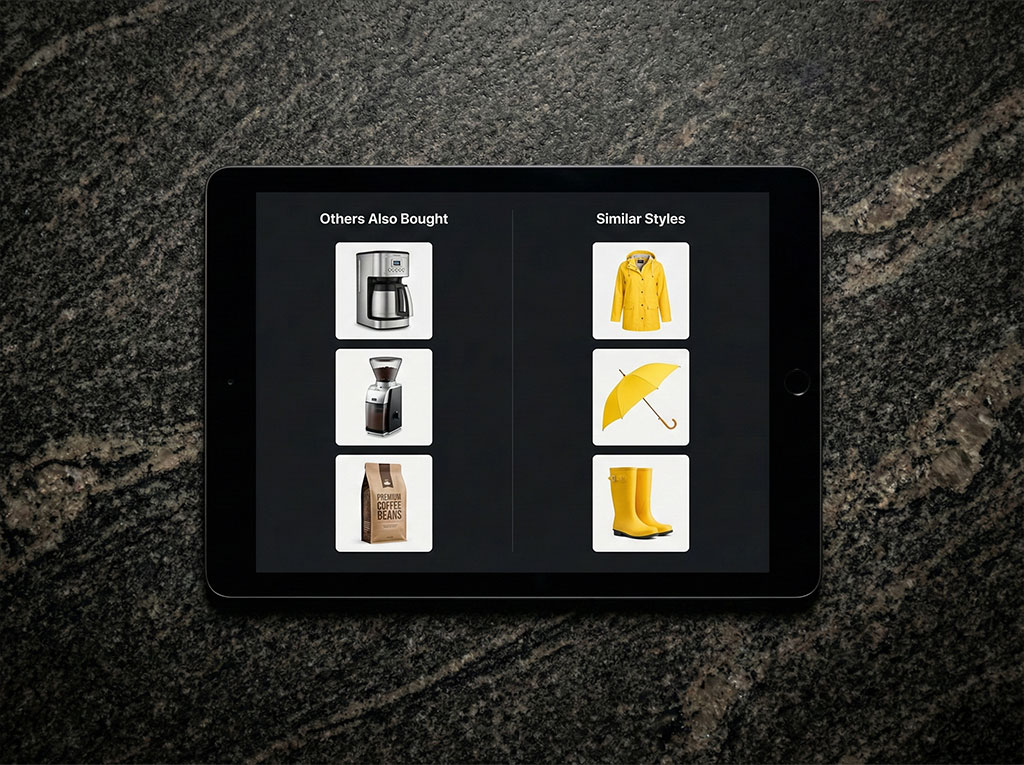
- Collaborative Filtering: This popular technique recommends items based on the collective behavior of similar users. It operates on the principle of social proof: "Customers who bought this also bought..." It works by analyzing a massive user-item matrix to find shoppers with similar tastes. The system then recommends products that other, like-minded users have purchased or rated highly, making it excellent for discovering new and popular items.
- Content-Based Filtering: This method suggests products based on their intrinsic attributes. It creates a profile of a user's preferences (e.g., they like a certain brand, color, or style) and then recommends other items that share those same attributes. A classic example is, "Because you liked this movie..." This technique is highly effective for niche products but can sometimes limit discovery to items that are too similar to what the user already knows.
- Hybrid Models: To overcome the limitations of a single approach, most advanced recommendation systems use hybrid models. These combine the social proof of collaborative filtering with the attribute-matching of content-based filtering techniques, resulting in more accurate, diverse, and serendipitous recommendations that are less susceptible to common issues like the "cold start" problem.
What is the business impact of smart recommendations?
Smart product recommendations deliver a significant, measurable impact that goes far beyond simply showing a few extra items. When implemented correctly, they become a core engine for growth, directly influencing the most important metrics for an e-commerce business. Product recommendations can account for up to 31% of e-commerce revenues. Their value can be seen across three key areas:
- Direct Financial Gains: This is the most immediate and compelling impact. By strategically up-selling and cross-selling relevant products at key moments in the checkout funnel, smart recommendations are a proven method for increasing sales, conversion rates, and Average Order Value (AOV). They capitalize on a customer's existing purchase intent to maximize the value of every single transaction.
- Enhanced Customer Experience & Loyalty: By creating a tailored and efficient shopping journey, recommendations greatly enhance the customer experience (UX). They make shoppers feel understood, which in turn fosters improved customer loyalty and encourages repeat business. Instead of a frustrating, one-size-fits-all experience, customers get a curated path that respects their time and preferences.
- Improved Product Discovery: In stores with large catalogs, many products can remain hidden or undiscovered through normal browsing. Recommendations solve this problem by helping customers navigate the catalog and find new items they will love. 49% of consumers said they have purchased a product that they did not initially intend to buy after receiving a personalized recommendation. .
Which strategic recommendation models increase AOV?
Strategic product recommendation models increase Average Order Value (AOV) through targeted suggestions. Key types include "Frequently Bought Together" for product bundling, up-selling to suggest premium versions of items, and cross-selling complementary products. These models use AI and are placed on product pages or in the shopping cart to maximize impact.
To achieve this, merchants can deploy several proven recommendation models in high-impact locations. Here are some of the most effective:
- "Frequently Bought Together" (Bundling): This is a classic and powerful cross-selling model. It groups complementary products that are often purchased in the same order (e.g., a camera, a memory card, and a case) and allows the customer to add them all to the cart in a single click. This is one of the most direct ways to increase the value of a single transaction.
- Rule-Based Up-selling: The goal of an upsell is to persuade the customer to purchase a more expensive, premium version of the product they are currently viewing. This can be a model with more features, a larger size, or a higher-quality material. By targeting a user who has already demonstrated strong purchase intent, this model directly lifts the final sale price.
- In-Cart Cross-selling: This model suggests complementary items after a customer has added a product to their cart. Suggesting batteries for an electronic toy or a specific cleaning product for a pair of shoes at this key moment is a highly effective, low-friction way to increase AOV.
- "Customers Who Viewed This Also Viewed": While primarily a tool for product discovery, this model uses social proof to keep users engaged and browsing. By showing a customer what their peers found interesting, it increases the chance they will discover and add more items to their cart than they originally intended.
The effectiveness of these models is maximized through strategic placement. Displaying them on product pages, directly within the shopping cart, or via targeted pop-ups ensures the suggestions are seen at the moments a customer is most likely to make a purchase decision.

What are the challenges and limitations of recommendation systems?
While highly effective, implementing a truly powerful product recommendation system is not without its common challenges. The primary obstacle is often related to data quality and quantity, a problem encapsulated by the "cold start" issue. This occurs when new users arrive with no browsing or purchase history, or when new products are added to the catalog. With no data to analyze, the algorithm cannot make accurate, personalized suggestions. Another significant risk is the creation of algorithmic biases, which can lead to "filter bubbles." The system may become so effective at showing users what they already like that it inadvertently prevents them from discovering new or different products, ultimately narrowing their experience. Furthermore, accurately predicting rapidly changing user preferences is an inherently complex task. Many default recommendation tools built into e-commerce platforms like Shopify often lack the sophisticated algorithms and customization options needed to overcome these challenges, failing to provide the dynamic, context-aware suggestions required to truly maximize their revenue-generating potential.
How to choose the right recommendation tool for Shopify
Choosing the right tool is critical, but its success begins with a fundamental prerequisite: the quality of your product data. It's important to recognize that a recommendation engine, no matter how intelligent, can only work with the information it is given. No AI can generate meaningful, personalized suggestions from incomplete, inaccurate, or poorly structured product metadata. In short, the relevance of your recommendations will always be limited by the quality of your product catalog.
Once you have committed to the foundational work of maintaining a clean and detailed product catalog, the challenge shifts from data management to implementing the complex technology required to leverage that data effectively. This is where the right tool becomes a game-changer. You should look for a solution that goes far beyond Shopify's default options, which often lack the algorithmic sophistication to truly capitalize on good data.
An advanced tool should provide a powerful, AI-powered recommendation engine that learns from user behavior in real-time. Rapid Search offers such a solution, designed to be the intelligent layer that sits on top of your quality data. It enables merchants to easily create and manage a variety of smart recommendation widgets, from personalized behavioral suggestions to rule-based up-selling, all supported by advanced analytics. By handling the complex technological heavy lifting, it empowers store owners to unlock predictable business growth and significantly increase their AOV.